
 Sign in
About Native Americans, snow and mud
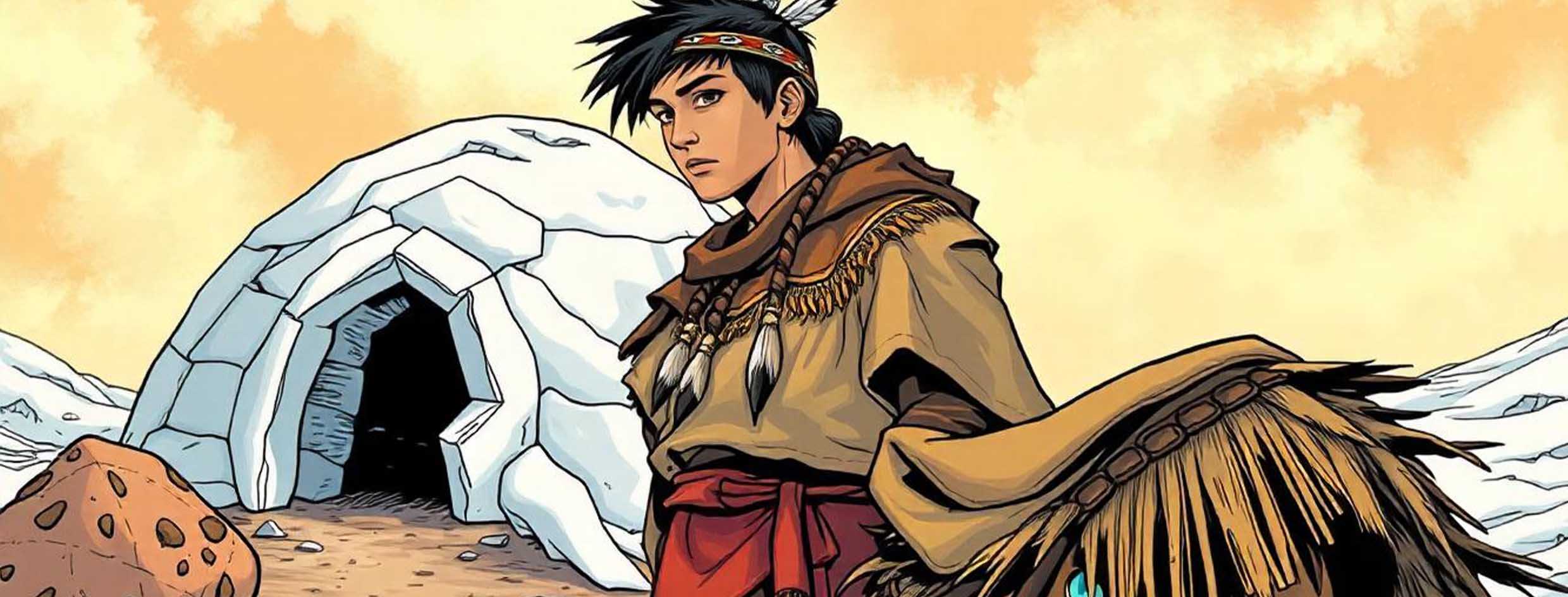
I asked Mrs. AI to create a nice Native American young man in front of a snowy igloo. Did she succeed?
As part of the family topic, we learn in gan about types of houses around the world.
While designing the materials for "Houses Around the World" and "Moli Tells About Houses and Materials," I did some digging online. To create amazing, accurate products, that's a must. What can I tell you, I almost became an expert in vernacular architecture* :).
(*I won't confuse you with difficult words. This whole post was born so you won't have to google. Vernacular architecture means folk building with local materials.)
While working, I discovered how interesting and fascinating this topic is. What's its value for life? I don't know. I'd love for you to tell me. But either way, even if it's only meant to broaden our general knowledge, it's worth it…

I gathered a few very brief words on the topic for you, so you won’t have to dig like I did:
A few words about tents. Or: why do people live in tents at all?
The main dwellers in tents are nomads. Nomads need a mobile home, since they move from place to place.
The tent was a perfect solution for their needs, since it's portable, simple to put up, easy to take apart and, of course, stable and protective against the weather.
The tipi – a Native American tent
Native Americans, the ones we know from history class, used to live in a tent called a tipi.
Why tipi? It turns out that in the language of the Sioux (the Native Americans who lived on the Great Plains of North America), the word tipi means house.
The tipi is a cone-shaped tent covered with bison hides. It has a ventilation opening at the top that can be closed and opened as needed.
Today, the tipi is hardly used as a home anymore, but it appears as a tourist attraction.
The Bedouin tent
The Bedouins, desert nomads, live in tents woven from cotton threads and animal hair.
The tent is divided into two parts: one for living and one for storage.
The tent protects against the strong desert sun.
Today Bedouin tents are used not only as homes but also for tourism. Many Bedouins run tourist sites where visitors can experience life in a Bedouin tent, taste traditional food and learn about Bedouin culture.
The yurt
The yurt (or yurta in Russian) is a round, unique tent used by various nomadic groups in the steppes of Central Asia.
It’s designed in a lattice shape and made of a wooden frame covered with sheep’s wool.
Although the original yurt was considered portable, modern yurts are used as permanent homes and are made of various materials. Only the beautiful shape has stayed 🙂
The igloo
The igloo, as you probably know, is the ice house of the Inuit (Eskimos) who live in frozen regions.
The igloo isn't just a shelter from the bitter cold, but also a symbol of Inuit culture, of adapting to an extreme climate, and of impressive engineering skills.
The igloo is dome-shaped, and it withstands strong winds.
To build an igloo you need packed snow (how do you pack snow? Leave that to the wind, it does a great job). The packed snow is neatly cut into bricks, and the bricks are stacked on top of each other in a spiral.
The Inuit make a low entrance and a short tunnel leading into the inner space, to prevent heat loss.
By the way, the igloo isn’t a permanent home. In summer, when the snow melts, the Inuit live in tents made of hides.
A few words about building with earth:
Earth building or mud building is an ancient building method that was common in many places around the world.
This building method uses earth as its main raw material.
The gojo – a traditional Ethiopian mud house
A gojo is a traditional mud house common in Ethiopia.
It’s built from natural materials found nearby, without mechanical tools or industrial materials.
The gojo has a round outer house built of wooden logs and plastered with mud from the local clay soil.
The straw house
Straw houses were built in places where straw was plentiful and other building materials weren’t.
The walls are strong and fire-resistant because they’re made of compressed straw with low oxygen permeability.
Do you have anything else to add on the topic? I’d love to read you in the comments.