 Sign in
Mud, puddles and boots: Mom’s struggle and the child’s joy
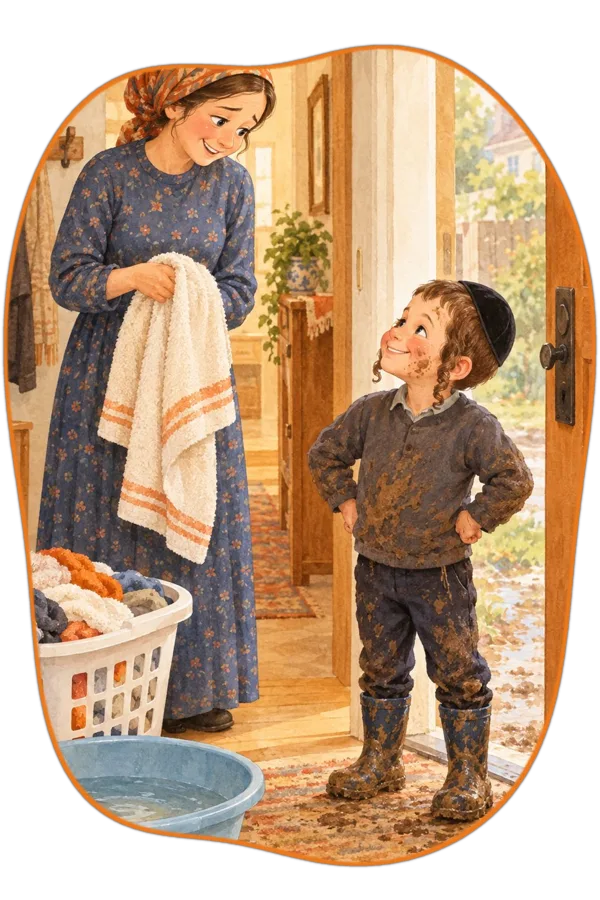
He flings the door open, tosses his schoolbag to one side, runs to see what you cooked, and you’re looking in only one direction: the floor.
Big patches of mud decorate it.
The floor you washed two hours ago.
You knew it was coming. It rained all day yesterday, and today, when you walked him to gan, you saw it – a lovely, wet puddle.
Know those moments? Me too. That's exactly why I wrote this post – a little about the child's joy, a little about our own struggle, and lots of ideas for turning it into a good experience for both sides.
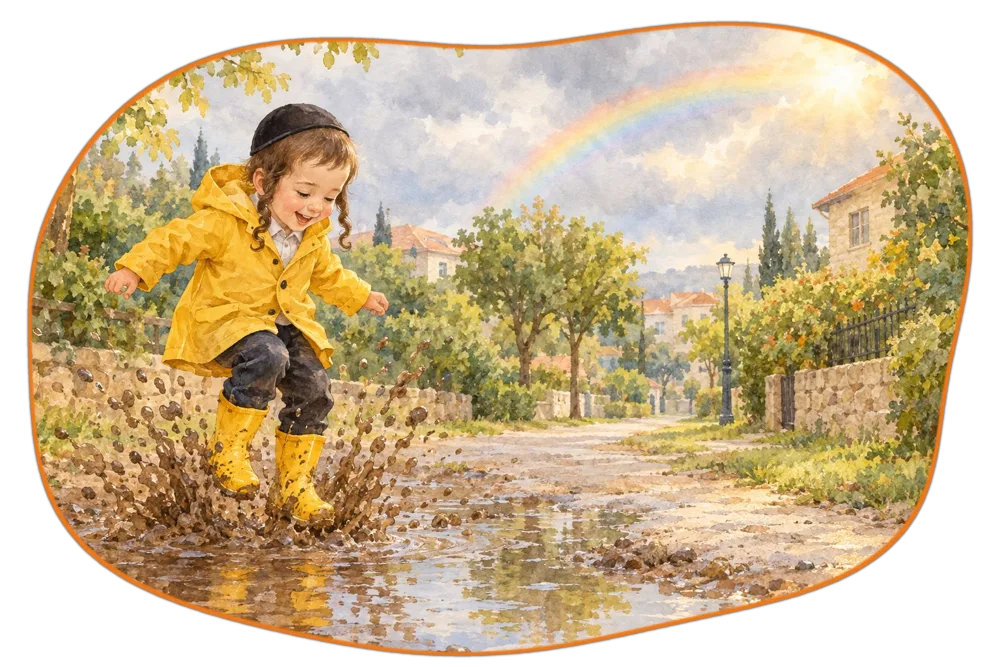
Why do children love mud and puddles so much?
For a little child, a puddle isn't dirt. He's also not thinking about the stains you'll have to scrub in the laundry later. What he sees in front of him is a playground, a laboratory and a private pool.
- A full sensory experience: mud is soft, cold, sticky and slippery. Water splashes in every direction. No toy gives so many sensations all at once.
- Cause and effect: a big jump gives a big splash. A gentle jump gives little ripples. That's how you learn physics at age four.
- A sense of freedom: most of the day he hears "careful," "don't get dirty," "sit nicely." The puddle is a place where it's allowed.
- A body in motion: jumping, balancing and landing on a slippery surface strengthen the muscles and self-confidence.
- Imagination: a puddle can be a sea, a lake or a river you have to cross. A leaf floating on it becomes a boat.
And what about Mom? Let’s talk about it honestly
You can write a hundred posts about how healthy and educational mud is, but a mother’s struggle is completely real. And it’s okay to admit it:
- The laundry. Another load, and sometimes stains that won't come out.
- The house. Muddy footprints in the hallway, wet boots and a coat that has to be dry by tomorrow.
- The worry. That he won't catch a cold, won't slip, won't get soaked to the bone.
- The time. An outing planned for five minutes turns into half an hour, followed by a bath you hadn't planned.
- What people will say. My child comes home looking like a sack of potatoes, and the neighbor is watching.
All of these make sense. The goal isn't to give up your rules, but to find a way where your child gets his joy and you stay sane.
How to cope? 8 practical tips
- "Puddle clothes." Old pants and a sweater that are allowed to get dirty. When he's wearing them, nobody gets stressed.
- The right gear. Rain boots and a raincoat are worth every penny. With good gear, most of the mud stays outside.
- An entry station. A tub of water, an old towel and a bag for clothes, by the door. Everything comes off before going into the house.
- Clear rules in advance. "We only jump in this puddle," "We don't touch the mud with our hands," "When Mom says 'we're done,' we go."
- A timer. "Five more minutes of jumping." Children accept a time limit much better when they know it in advance.
- Turn it into a game. Who can make the biggest splash? Who can jump the most gently without splashing? How many steps from one end to the other?
- An after-ritual. A warm shower, pajamas and tea. That way the experience ends on a pleasant note, not in an argument.
- Shift your perspective a little. Twenty years from now he won't remember the stain on his pants. He'll remember that Mom let him jump.
And if you really don’t have the energy today?
That's perfectly fine. Not every rain has to end in mud. You can just go out and stand under an umbrella listening to the drops, look at the puddle from the window, or make "mud" at home: a box of soil and water on a tray, old clothes, and ten minutes of play on the balcony.
What can we learn from one puddle?
Since we’re already outside, why not enjoy the learning value too?
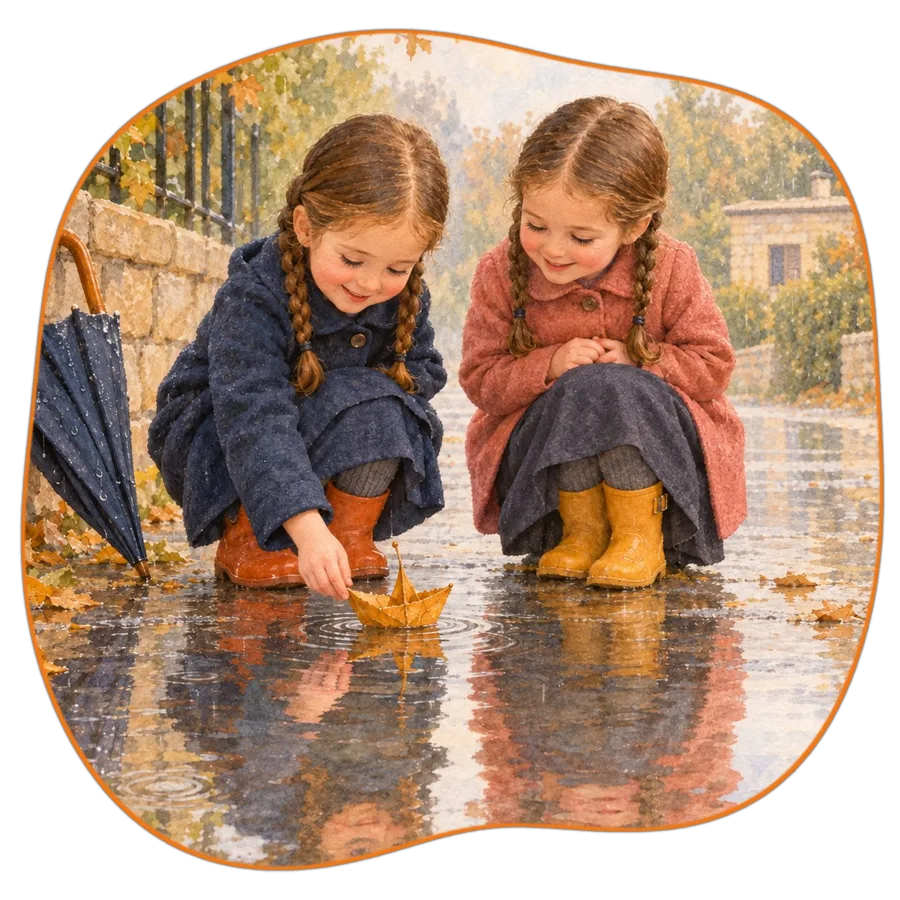
- Reflections: we look into the puddle and see the sky, the trees and ourselves. Why does that happen?
- Leaf boats: which leaf floats and which one sinks? What happens when we blow on it?
- Measuring: how many steps long is the puddle? Will it be bigger or smaller tomorrow?
- Where does the water go? Come back the next day and check. Some soaked into the ground and some evaporated in the sun. That's exactly the beginning of the water cycle.
- New words: drizzle, shower, puddle, sponge, slippery, muddy, reflection.
Rain is a blessing
And before anything else, it's worth reminding the children: rain is a blessing from Hashem. Thanks to it, plants grow, trees give fruit and the wells fill up. The puddle your child is jumping in is a small part of that big blessing. You can stop for a moment together and say: "Thank You, Hashem, for the rain."
Want to continue the experience in gan or at home?
We've prepared print-ready materials on rain and winter. For example the illustrated story "Shmulik Waits for the Rain", the "Where Does Rain Come From?" exploration kit with simple water-cycle experiments, and the weekly preschool unit "Rain, a Blessing from Hashem".
And if you want it all together, we have a complete winter bundle with 10 items at a reduced price.
And how is it with you? Do the kids jump in puddles or keep their boots clean? Do you have a winning trick for mud? Share it with us in the comments.